
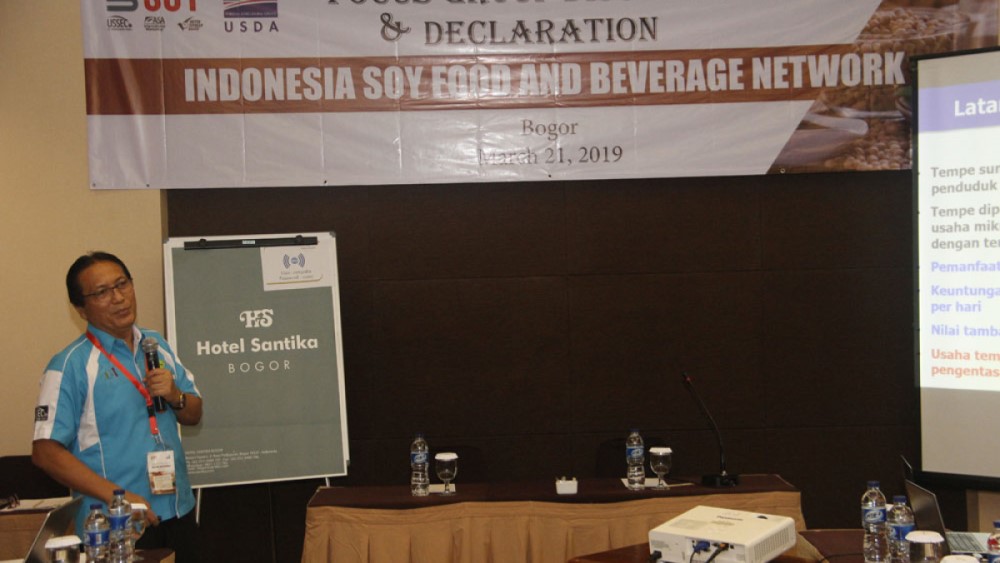
Lesson learned from The Indonesian Tempe Forum
Presented by: Prof. Made Astawan, The Indonesian Tempe Forum
Presented in: Focus Group Discussion & Declaration of Indonesia Soy Food and Beverage Network
The focus of the presentation were background of Indonesian Tempe Forum (FTI)’s formation, explanation of FTI’s activities, explanation of FTI’s organizational structure, and things that need to be prepared by SOYBEAN Indonesia as an organization.
The purpose of FTI’s establishment is to provide and share comprehensive information within development of tempe in the future. FTI is a non-profit organization trying to promote tempe as Indonesia’s cultural heritage
The factors that constitute the background for FTI’s formation were:
- The economic crisis in 2008 which caused soybean prices to soar
- High consumption of tempe in Indonesia. Soybean consumption in Indonesia is dominated by tempe (70%)
- Tempe business have a real role in alleviating poverty in Indonesia. Tempe produced by Micro small medium enterprise have net profit per business unit of Rp.100-400 thousand per day. Value added by tempe industries: IDR 37 trillion / year.
- The condition of unhygienic tempe producers, inefficient production processes, and low awareness of producers on new technology.
The activities carried out by FTI are as follows:
- Socialization and promotion of tempe consumption
- Speakers at various seminars
- Compile a module of hygienic tempe production
- Conducting Tempe producer training & TOT
- Conduct national & international seminars
- Take an active role in the preparation of tempe standards
- Propose a national tempe day
- Establish Indonesian tempe house
- Propose tempe as Intangible Cultural Heritage to UNESCO
- Build Tempe Land
One of the achievements of FTI is Indonesian Tempe House (RTI) which aims to be learning center on how to produce hygienic tempe through GMP (Good Manufacturing Practices) application. The certifications which RTI achieved are SNI, halal, HACCP, and MD permission.
The RTI concept has been adopted and applied in 27 provinces

